
The SEO and AEO Problems We See Again and Again
We've been working with businesses on their search visibility for a while now, and the same problems keep showing up. Different industries, different sites, the same handful of small things piling up. A missing tag here, a page that has no supporting links to other pages. Content that reads alright to a person but it’s just a compilation of resources pulled from Google.
The frustrating part is that none of it is obvious from the outside. Your site looks fine. It just doesn't show up.
And today, people aren't just searching on Google anymore. They're asking ChatGPT, Gemini, and Perplexity too. So now there are two jobs to get right: SEO, which gets you found in search results, and AEO (Answer Engine Optimization), which gets you mentioned when AI writes the answer.
Here are the problems we run into most, and what to do about each one.
However, something worth noting down - most of the fixes we do, depend heavily on what industry you operate in, so some of these fixes may not always be the answer.
1. Missing, duplicate or copy-paste meta data
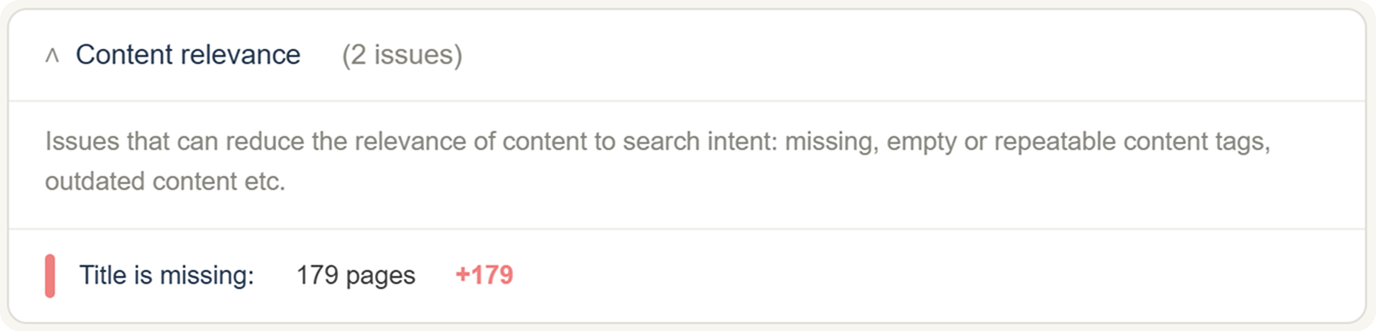
This is a basic need, and a key pillar in SEO. Your title tag is the line someone reads before they decide to click. It's also one of the strongest signals you get to control. When it's missing, generic, or the same across twenty pages, you're giving Google nothing and giving the searcher no reason to pick you.
Give every page that matters its own clear title, description, image and make sure the descriptions are written the way your customer would actually search. When we rewrote the meta data on an Australian dental client's contact page, clicks increased 2.5x in just four weeks.
2. Pages with zero links and structure
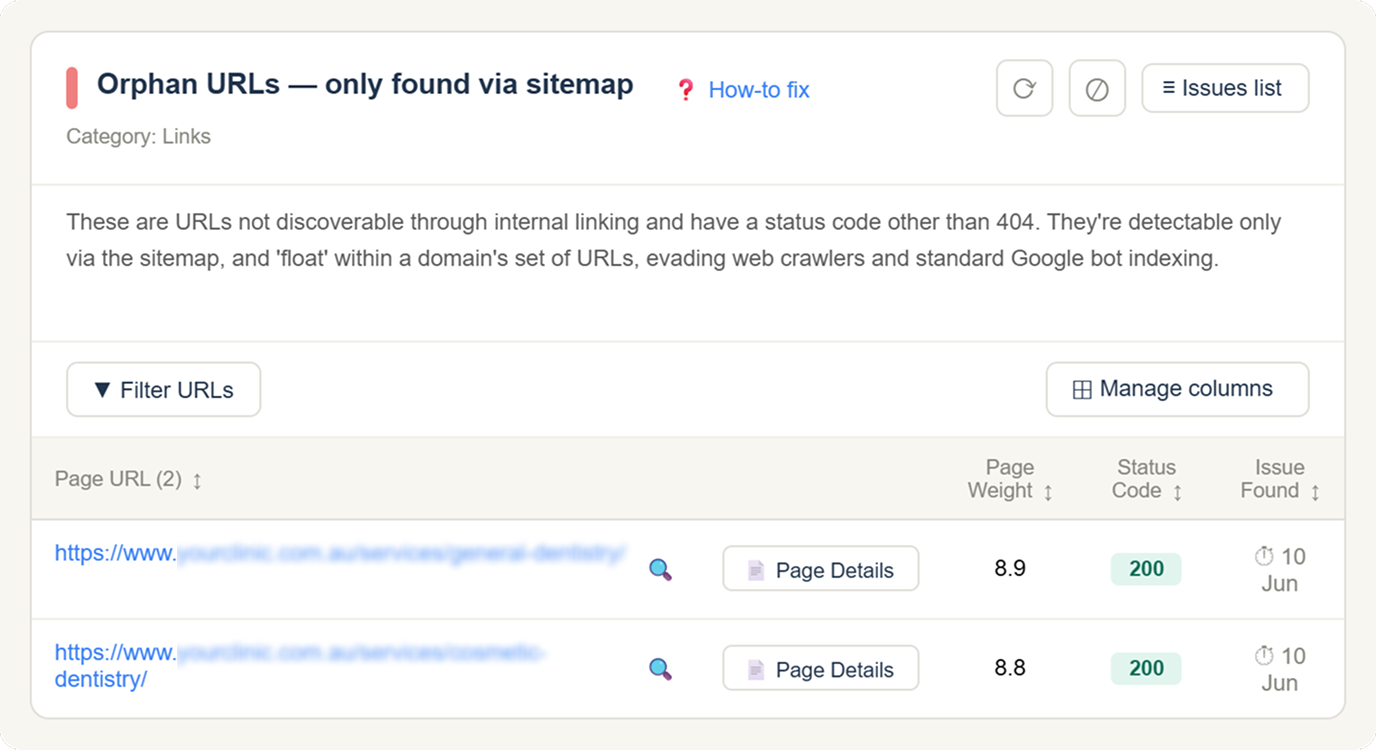
An orphan page is a page on your site that no other page links to. Google might still find it through your sitemap, but with nothing pointing to it, it gets no weight from the rest of your site. The result is poor rankings and pages that are basically invisible.
We find these all the time - especially on bigger sites that grow one page at a time. Pull them back in. Link to them from your category pages and related content. That's how authority moves around your site.
An audit for a client in the AI and governance space turned up more than 400 pages with no internal linking. Nothing pointed to any other page, so users had no path from one page to the next.
3. A sitemap that's out of date or was never submitted
Your sitemap tells Google what pages you have and where to find them. When it's out of date, missing your newest pages, or was never submitted at all, your pages take longer to get found.
Rebuild it so it matches your live pages, drop the ones you don't want indexed, and submit it in Google Search Console. Then keep it current.
We saw this with a wholesale organic spice supplier in Fiji. The site had no structure and no sitemap had ever been generated, let alone submitted. Google was left to find the pages on its own.
To check this - go to yoursite.com/sitemap.xml. If a page of URLs loads, you have one. If you get a 404, you don't.
Most platforms do this for you and update it automatically every time you publish.
Squarespace and Shopify build one by default at /sitemap.xml, so there’s nothing to install. WordPress builds a basic one by default, or uses Yoast or Rank Math for more control.
Webflow generates one once you enable auto-sitemap in site settings. Custom or static sites are the only case where you generate it yourself, either with a crawler like Screaming Frog or as part of your build process.
4. No tracking in place
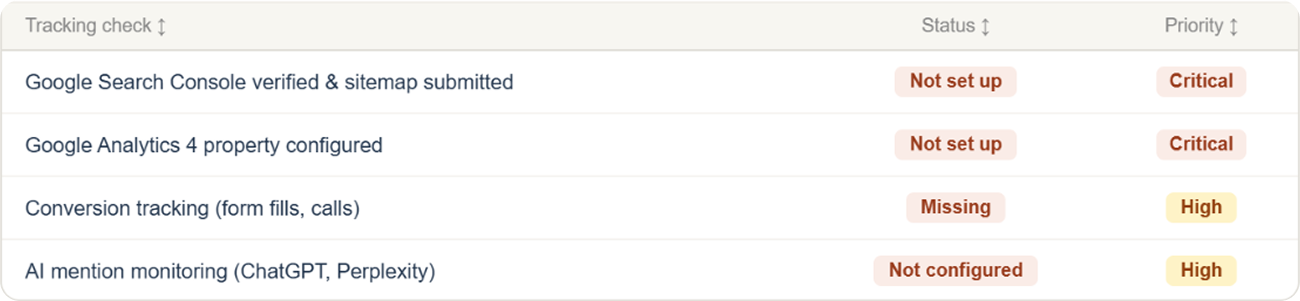
More than once we've opened up a client's account to find Search Console and Google Analytics were never properly set up. That means no clear view of what's ranking, what's driving traffic, or what people do once they land.
Without that, you can't prove what's working or decide what to fix next.
Get the basics first. Verify Search Console, set up Analytics, track your goals like form fills and calls. Then add AI tracking so you can see where you're being mentioned
5. No structured data
Structured data or schema markup is a bit of code that spells out what a page is: a product, a service, an FAQ, a local business. Without it, you're asking Google to guess. With it, you rank higher on search results, and AI engines find it much easier to pull from your page and cite you.
This matters more for AI than most people realize. Pages with clean structured data and simple FAQ sections tend to get picked up in AI answers far more often. Add the right markup for each page and make sure it isn't throwing errors.
We built a free AI search audit, so anyone can get an idea as to where they stand in terms of AI search optimization in 5 minutes.

6. Content that doesn't match how people search
Plenty of sites rank for nothing because the content was written for the business, not the customer. It describes services in the company's own words instead of answering the questions people are typing and asking out loud.
That gap got wider with AI. People don't search in three clipped words anymore. They ask full questions, and AI answers them by grabbing content that answers those questions clearly. Thin surface-level pages give it nothing to work with.
For the Australian dental client, we looked at how patients searched, sorted those searches by what people wanted, and built content to match. Impressions grew 193% and the clinic started getting quoted in Google's AI answer within 4 weeks. Read part 1 and part 2 of the case study here for more details.
Figure out the real questions your customers ask. Answer them properly, in plain language.
7. Lack of credibility
Google and AI both lean on trust. If your content has no clear author, no proof you know your stuff, and no sources behind your claims, there's not much reason to rank you and even less reason to quote you.
Show who wrote it and why they'd know. Back up what you say. Keep pages fresh, because newer content tends to get cited more. You don't have to be the biggest name in your industry. You just have to make sure your content is original and is written by trusted sources.
8. Missing from local search
If you serve a place, your local details need to line up. Business name, address, and phone numbers should be identical everywhere they show up online. You can put this up as schema tags too. Your Google Business Profile should be filled out, not half done. When these are messy or missing, you won't show up when someone nearby is searching for exactly what you do.
The thing they all have in common
Almost every problem here comes down to one thing - make it easy for Google and AI to find your content, understand it, and trust it enough to use it. Fix the technical stuff so your pages can be seen. Write so you're answering real questions by the public. Give people a reason to trust you. Then track it so you know what's working.Top of your priorities should be:
Fix what's blocking you - Site map, internal link structure, site structure and meta data.
Answer the questions people actually ask - Forget about targeting multiple topics and stuffing articles with irrelevant keywords. Focus on 4-5 high-intent keywords, and build content pillars around what your product/ service solves.
Give them a reason to trust you - customer impact stories, named authors, specific results. AI systems and search engines both lean toward sources that show their work.
This is what we do at Ancore. Our team has been working with brands across healthcare, ecommerce, and professional services to make sure they get found by Google and AI.